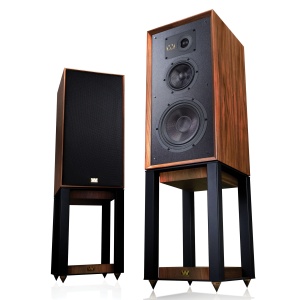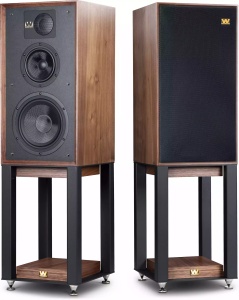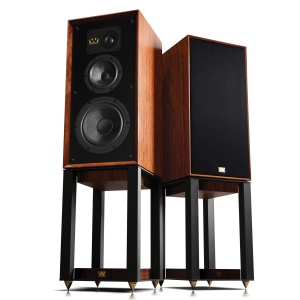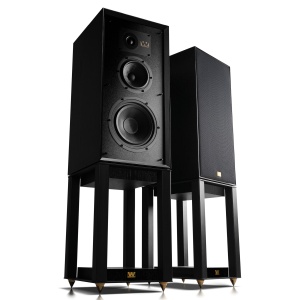
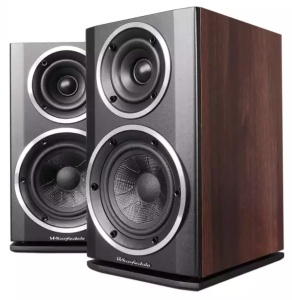


WHARFEDALE Diamond 121 Walnut Pearl

Wharfedale
23.880,00 RSD / par
19.900,00 RSD / par (bez PDV-a)
Wharfedale
Besplatna dostava
Kod proizvoda - SKU 09955
Pozovite nas

Opis

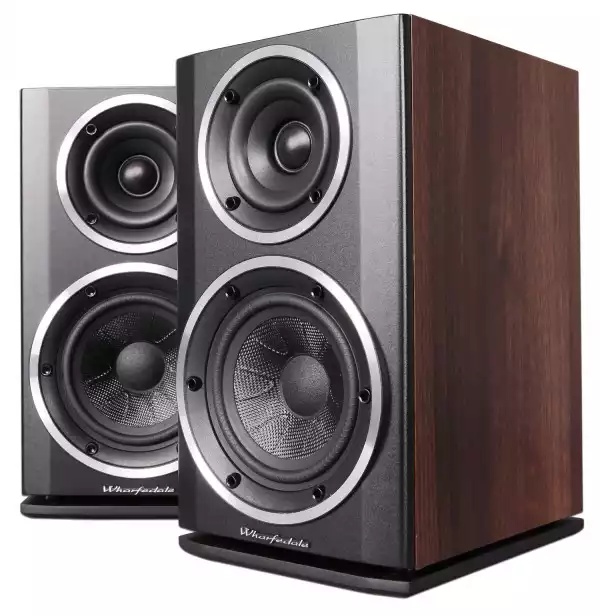
Diamond 121 Walnut Pearl


  2-way Bookshelf Speaker
  Enclosure Type Bass Reflex
  Transducer Complement 2-way
  Bass Driver 130mm Woven Kevlar Cone
  Treble Driver 25mm Soft Dome
  AV Shield No
  Sensitivity (2.83V @ 1m) 86dB
  Recommended Amplifier Power 25-100W
  Peak SPL 95dB
  Nominal Impedance 8 Ohms Compatible
  Minimum Impedance 4.1 Ohms
  Frequency Response (+/-3dB) 50Hz - 20kHz
  Bass Extension (-6dB) 45Hz
  Crossover Frequency 2kHz
  Cabinet Volume (in litres) 7L
  Dimensions (H x W x D) 315 x 174 x 225 (mm)
  Net Weight

5.3kg/pcs

 
Driver Performance
 
As you would expect from a series of this stature,
the Diamond 100 is bang up to date in terms of
technology and performance. Foremost in the
design criteria for Diamond 100 is the ongoing
research into loudspeaker driver sound quality. To
that end the famous Wharfedale Woven Kevlar cone
was put under the technology spotlight and given a
new profile based on the research originally carried
out for the high-end Jade range.

Incorporated in the low frequency and midrange
cones are semi-elliptical ‘break-up’ areas which
smooth the response throughout the audible range.
In addition each surround is treated to match
the cone edge with a unique ‘Diamond Pattern’
moulding. Finally the dust cap is blended and
treated to provide a smooth transition and perfect
acoustic match to the treble unit.

The treble unit chosen for Diamond 100 came
under equal scrutiny during development. As well
as selecting a sheer fabric dome and advanced
ferrite magnet system, the dome is surrounded
by a carefully crafted wave guide that encourages
outstanding midrange performance.
 
 
Crossover
 
Combining the drivers is a crossover developed
using Wharfedale’s latest ‘Virtual Speaker ’
software. Techniques developed in-house allow
the final loudspeaker to be simulated and fully
analysed even before a prototype is played for the
first time. This simulation accommodates driver
performance and cabinet construction, as well as
room placement, to make sure that both on-axis and
off-axis performance over a wide listening area is
fully optimized.
 
 
Cabinet Design
 
Naturally cabinet design was not forgotten in
amongst all the other technology. Rectilinear cabinet
shapes were chosen to maximize the internal
volume and provide the deepest, most extended
bass response. Again the research from the highend
Jade series was incorporated to elicit the latest
advance in loudspeaker reflex loading – the Slot-
Loaded Distributed Port.

Exiting at the base of the speaker cabinet, the refl ex
port is loaded by a slot created by the plinth. This
equalises the air pressure to mimic that inside
the cabinet allowing smooth transition between
the pressure variation in the cabinet and the low
frequency sound developed in the room.

Cabinet walls and internal bracing were also
incorporated in the ‘Virtual Speaker’ model, with
the help of Delayed Cumulative Spectral Analysis
that ruthlessly reveals panel coloration in all its
forms. Using this technique Wharfedale engineers
formulated a cabinet panel construction of multigrain
faceted boards bonded together to damp
annoying High-Q resonances and block internal
sound leakage. The effect is that the ‘noise’ from
cabinet walls is buried more than 35dB below
the driver output. In Diamond 100 all you hear is
crystal clear music from the drive units without
any attendant coloration from the cabinet. Again
computer analysis helped refine this novel
technique, but the result is an audibly superior bass
performance of great articulation and clarity.
 
 
The Real Test
 
That doesn’t mean that Diamond 100 is purely a
computer design, clever though that might be.
This ‘Virtual Speaker’ is simply a tool that allows
the Wharfedale engineers to explore all facets of
the loudspeaker ’s performance before starting
listening tests. In the final evaluation weeks are
spent fine tuning the acoustic performance using a
wide variety of music in Wharfedale’s five listening
rooms, each of which mimics the kind of domestic
environments the Diamond Series are likely to be
used in.
Only when the acoustic tests are deemed truly
satisfying are the loudspeaker designs signed-off
for production, ensuring that each speaker model
fulfils its eventual owner’s dreams of musically
enjoyable reproduction from Britain’s Most Famous
Loudspeakers.


  • Wenge
  • Walnut Pearl
  • Blackwood

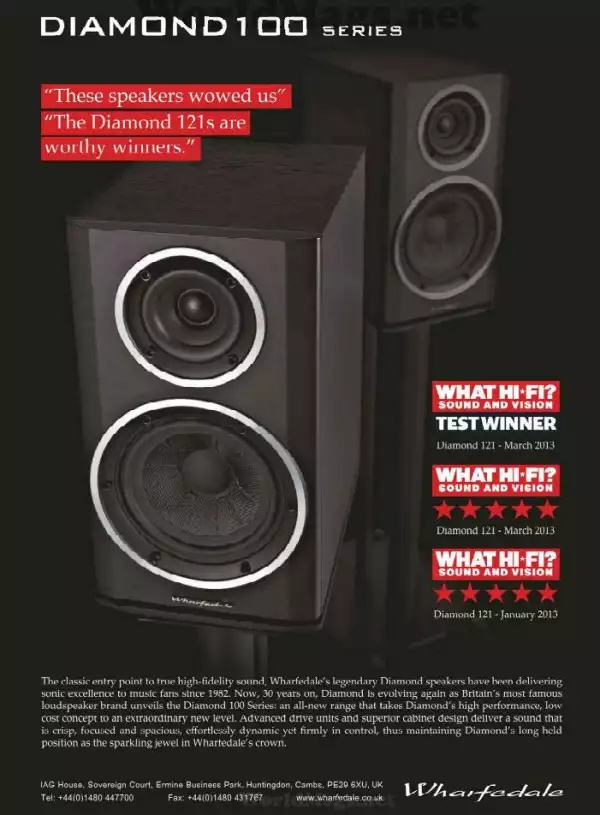
Over the past 30 years, the Diamond series speakers have formed the core of Wharfedale’s output in one form or another. 

Consistency has been a problem: generations five through seven weren’t great. Since then, though, every new version has hit the mark. None more so than the 11th generation Wharfedale Diamond 121 we have here.

For marketing reasons the company has decided to call this generation the 100 series, but the Diamond 11 is really what it is.

Wharfedale Diamond 100 Series
All the 100 series products – two standmounters, four floorstanders and a pair of centre speakers – share a common DNA, and this starter model, the Diamond 121, is a good representation of the range.

The drive units are all new. The 13cm woven Kevlar mid/bass features a new cone profile with ridged patterns to help control behaviour, and a blended dust cap to improve smoothness at the crossover.

The tweeter is surrounded by a deeply dished waveguide, which helps efficiency, particularly through the crossover region.

Wharfedale 121: Features
While it’s tempting to think Wharfedale has taken the cheap option by returning to a conventionally rectangular cabinet (from the curved enclosures of the previous generation), the truth is a little more complicated.

Yes, rectangular boxes are cheaper to make, but the cost savings have allowed the engineers to be more ambitious with drive units and cabinet construction.

The cabinet uses composite wooden panels to help damp resonances and prevent sound transmission through the enclosure walls, so you hear more of the drive units and less of the box.

The 121 also features what Wharfedale calls a ‘slot-loaded distributed port’. It’s an attempt to get deeper, more extended bass from a compact design, and to make the speakers less fussy about placement. It’s elaborate engineering for a product at 
this price.

Wharfedale 121: Positioning
Instead of going down the usual route of a rear or front-firing reflex port, they've decided to fire the port downwards into a small gap between the base of the cabinet and the plinth below.

Not only does this technique help with port efficiency and the reduction of chuffing noise, it also makes the speaker less fussy about positioning in your listening room.

Judging by the low frequency output of the 121s, this arrangement seems to work really well. It's just a shame that the plinth felt a little insubstantial on our review model.

The 121s’ predecessor, the 10.1s, were sold at £150, so it comes as a surprise to find the 121s at £230. Manufacturing costs are rising all the time, but that’s quite a hike, particularly when classy alternatives such as Monitor Audio’s Bronze BX2 are £20 more.

Still, that price wouldn’t be a problem if performance and build were top-class. While the 121s are sturdy, some aspects of the finish struggle, especially the paint finish and vinyl wrap, which hasn’t been applied neatly enough. It’s annoying because, when it comes to sound quality, the 121s need fear no rival.

Wharfedale 121: Sound quality
Give these Wharfedales a sturdy pair of stands and use them relatively close to a rear wall, and you’ll get a terrific sound. There’s a sense of scale and authority that belies the speaker’s compact dimensions.

Much of the credit goes to the way they produce bass – low frequencies are solid, agile and tuneful, and have good reach. It seems that distributed-port idea works.

If the bass is good we’re even more impressed with the terrifically articulate and beautifully projected midrange. Treble is nicely judged too. There’s plenty of sparkle but enough refinement to ensure the 121s behave well enough with aggressive recordings and bright partnering equipment.

Put it all together and you have a pair of budget boxes that truly satisfy. They’re happy to charge along to The White Stripes, making the most of the music’s energy while refusing to make a meal of the low-fi nature of the recordings.

Equally, give them something wonderfully produced such as Johnny Cash’sSolitary Man and they’ll enthral with Cash’s rich, textured vocals and the track’s wonderfully sparse instrumentation.

Wharfedale 121: Use it with
While these speakers aren’t particularly fussy about partnering kit, sounding as happy with Onkyo’s energetic A9030 as they do with Rotel’s RA-10, it wasRega’s exceptional Brio-R that got the most out of them.

This is a terrific combination for small to medium rooms, delivering a breadth of insight, expression and rhythmic precision we don’t think can bettered for the money.

The Diamond 121s are brilliant performers. If Wharfedale takes a little more care in building them, rivals will really have a serious problem.


Informacije

SKU
09955
Kategorije
Proizvođač

Preporučeni proizvodi